I still remember the closed beta back in 2020, sitting in my dimly lit room, skeptical that a new tactical shooter could really dethrone the giants. Overwatch had its polished chaos and CS:GO was the undisputed king of precision, but Riot Games whispered a promise that got my trigger finger twitching: 128-tick servers. I'd been burned before by peeker's advantage—that invisible thief who gives the aggressor an unfair glance—so I strapped in, hoping for a smoother ride. Boy, did it deliver.
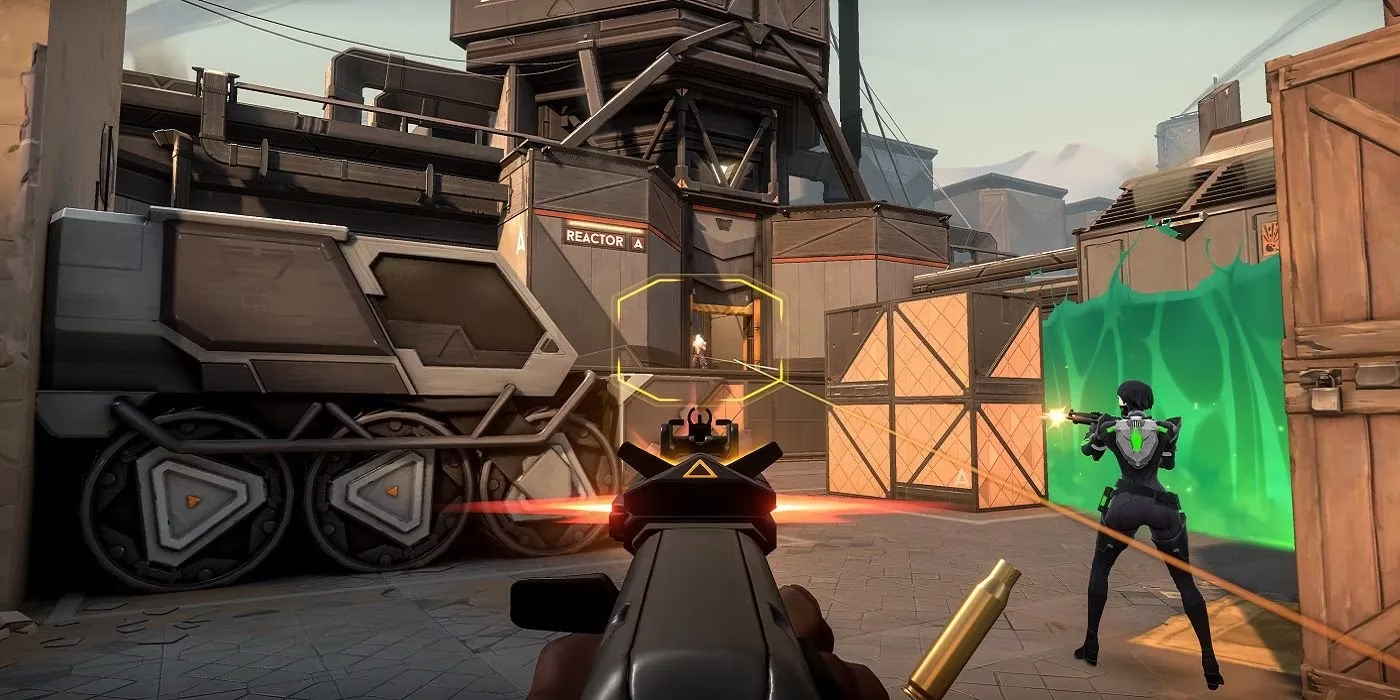
From that very first one-tap, I felt like my shots actually landed where my crosshair pointed. The servers refreshed the game state 128 times a second, double what my old love Overwatch could muster and leaving CS:GO’s 64hz in the dust. That number isn’t just jargon for network engineers—it’s the heartbeat of a fair duel. Every peek, every flick, every desperate wall-bang was validated by a system that felt almost clairvoyant. The game was reading my mind, or at least my packets, without that infuriating delay that had me screaming at past monitors.
Fast forward to 2026, and I’m still grinding ranked on a setup that’s seen better days, but the consistency of Valorant’s technical backbone keeps me coming back. Riot didn’t just slap a high number on a spec sheet and call it a day. They built Riot Direct, their own internet backbone, a sprawling web of cables and data centers that practically cradles my bullets from my PC to the opponent’s hitbox. In those early dev diaries, the team talked about scanning beta data to find where players gathered and then erecting new servers like digital lighthouses in empty seas. They weren’t kidding. Six years later, I can log in from a small town and find a 10-millisecond ping, a luxury that feels downright decadent.
The competitive edge this gave Valorant? It’s almost unfair—like showing up to a knife fight with a lightsaber. Traditional shooters had me second-guessing every death. Did the server miss my headshot? Did that Jett see me before I saw her because of a sluggish tick? In Valorant, the excuse jar is perpetually empty. A miss is my fault, and a hit is a crisp, satisfying reward. This brutally honest feedback loop molded me into a better player. I learned to trust the game, and that trust is the bedrock of any serious esport.
... and wow, has Valorant become a serious esport. The Overwatch League was a spectacle, and CS:GO majors were religious experiences, but Riot’s baby has carved its own cathedral. The high tick rate became a siren call for streamers and pros who were tired of blaming the netcode. One by one, they migrated, bringing their audiences and their insane aim with them. Tournaments now boast prize pools that would make a small country jealous, and the crowd noise when a 128-tick server validates an impossible operator flick is pure electricity. I’ve watched friends leap from their chairs, not in anger, but in sheer disbelief that the game registered their split-second heroism. That’s the magic you can’t put a price on.
There was this one match—I’ll never forget it—where I peeking mid on Ascent, a ballsy move with a Guardian. I saw the enemy Reyna’s shoulder, fired, and ducked back. On my screen, she was dead before I even registered the recoil. A buddy spectating me said, “That’s not human reaction time.” I just laughed. “It’s not. It’s Riot Direct, baby.” In those milliseconds, the server had already updated my kill, verified the packets, and sent the truth back to both clients. That’s peeker’s advantage turned on its head; the game is so fast that the peeker is just faster, not cheated. Cheaters, by the way, were given the boot almost instantly with Vanguard, Riot’s invasive but effective anti-cheat, which integrated with the high tick rate to make any foul play stick out like a sore thumb.
Still, a server tick rate alone doesn’t glue a player to a monitor for six years. The agent abilities, the map pools, the insane skin bundles—they all dance together. But the rhythm of that dance is kept by a metronome beating 128 times a second. Overwatch 2 tried to catch up, CS2 finally bumped its default competitive servers, but Valorant set the standard early and never let go. The industry learned a lesson: a game that respects its players’ time and reflexes will earn a loyalty that’s harder to break than a full-buy on match point.
I look at the younger generation of players, kids who have never experienced a 30-tick server, and I feel this strange mix of jealousy and pride. They think this instant feedback is standard. They don’t know the dark ages of dying around corners. I’m the old-timer at the LAN party, sipping my drink, saying, “Back in my day…” but I catch myself. Because in Valorant, every day still feels like a fair fight, and that’s a gift worth cherishing. The tick rate isn’t just a number; it’s the soul of the server, a relentless, invisible referee that never blinks.
So here’s to 128 ticks, to Riot Direct, and to the countless headshots that actually registered. If you’re still undecided, just hop into a custom match and feel the difference. You’ll notice the silence—no rage, no “how did he see me?”—just the clean, pure hit of a game that plays as fast as you can think. And in 2026, that’s the only way to play.