In the vast digital coliseum of competitive shooters, tactical depth often hides in the most unexpected crevices—like a clockmaker discovering that removing a single gear can turn a timepiece into a perpetual motion machine. This analogy became startlingly literal in 2020, when Valorant’s closed beta revealed a peculiar absence: a skybox. The lack of an artificial lid above maps birthed a strategy that felt less like a glitch and more like a celestial ambush, one that continues to echo through the game’s aerial warfare even now, in 2026.
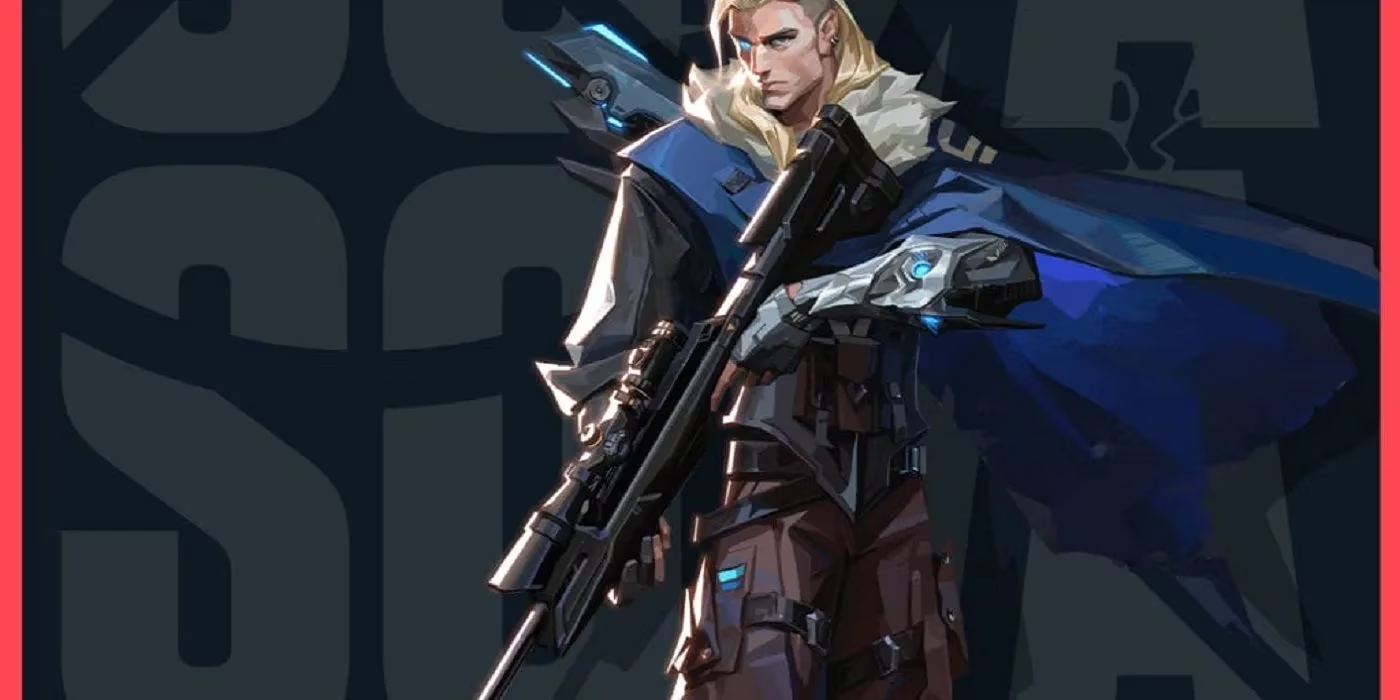
The incident that ignited this conversation was deceptively simple. A player on the defending side, after planting the spike, found themselves eliminated by a Sova Shock Bolt that descended from the heavens with no warning. The kill feed betrayed no immediate source; the projectile had been fired upward moments earlier and then, obeying the physics of a world without ceilings, reached an absurd apogee before gravity pulled it back to earth like a hawk spotting prey from the stratosphere. The victim, caught mid-defuse, became an unwilling testament to the fact that Valorant’s maps were open to the sky—and to the creativity of those who dared to exploit it.
The physics at play here resemble a bottle rocket launched in a vacuum chamber: ordinarily, a projectile would either strike an invisible barrier or despawn after a set distance. In Valorant, however, the absence of a skybox meant Sova’s bolts could traverse the entire vertical axis unimpeded, with travel time stretching into seconds. This turned each bolt into a time-delayed grenade, its fuse governed by the bolt’s initial velocity and the game’s gravity constant. For a character designed around reconnaissance and area denial, this oversight functioned as an unintended third ability—a delayed orbital strike that required no line of sight and no risk to the sender.
The community’s reaction was a blend of awe and exasperation. Reddit threads surged with clips titled “Raining Justice” and “Sova Space Program.” Some called it a game-breaking bug; others praised it as an emergent layer of high-skill expression. Developer Riot Games, renowned for meticulous balance, initially remained silent, leaving players to wonder whether the missing skybox was an intentional design choice or a ghost in the machine. Riot’s subsequent action—or rather, inaction—would define a whole era of vertical experimentation. Instead of patching it out entirely, the 0.50 patch introduced subtle constraints: Shock Bolts now had a maximum air time of approximately seven seconds, and their damage falloff over distance was slightly increased. This solution felt like placing a soft mesh over a boiling pot, allowing steam to escape while preventing a full explosion. The orbital mechanic remained viable, but it could no longer produce the minute-long hang times that made the original clips so surreal.
By 2026, what was once an accidental discovery has matured into a staple of high-ranked and professional play. Teams now routinely coordinate “sky darts”—pre-firing Shock Bolts into the air during post-plant scenarios, timing their descent with defuse attempts. The practice has spawned a micro-economy of lineups, each map having designated spots where a bolt can be arched to land on spike zones after 10, 15, or even 20 second delays. It’s a form of tactical choreography, akin to setting a sundial to mark the precise moment an enemy’s patience runs thin. Analysts have compared watching a perfect sky dart sequence to observing a cloud seeding operation: tiny particles injected into the atmosphere, seemingly innocuous, until they coalesce into a storm that breaks at the worst possible moment for the opposing team.
This evolution has not been without growing pains. The 2023 addition of a new aerial reconnaissance agent, Kestrel, who deploys a drone that can latch onto ceilings, reignited debates about the limits of verticality. Riot clarified that the game’s “ceiling” is technically a damage and collision plane set at an extremely high altitude—far above normal projectile ranges—but not a traditional skybox. This design philosophy, the developers explained, preserves the sandbox sensation while preventing true infinite loops. It’s a delicate balancing act, one that treats the sky not as a solid roof but as a deferred judgment, a safety net woven from attenuated damage and despawning timers rather than geometric barriers.
From a competitive standpoint, the missing skybox has injected a layer of psychological warfare that no minimap can fully capture. Defenders must now split their attention between corners and cumulus clouds, scanning for the faint audio cue of a descending bolt. The mechanic rewards spatial intelligence and timing in a way that conventional gunplay does not—it is the shooter equivalent of a chess player moving a knight to a square that will only threaten the opponent two turns later. For Sova mains, the sky is no longer an empty backdrop but an additional inventory slot, a place to store threats until the perfect moment. For their victims, it’s a reminder that in Valorant, danger doesn’t just lurk around the corner; it can plummet from the firmament with the precision of a falcon’s stoop.
Looking ahead, the 2026 competitive circuit suggests that aerial delay tactics are here to stay. Recent datamines hint at a new controller agent whose ultimate can temporarily manipulate projectile gravity within a zone, potentially bending sky darts back onto their senders. Such developments would only deepen the orbital meta, transforming the sky from a one-way delivery system into a contested arena. It’s a future that would have seemed absurd in the closed beta, where a single bolt falling from nowhere felt like a divine intervention.
In the end, Valorant’s accidental omission became its most distinctive vertical signature, turning a technical quirk into a canvas for player ingenuity. Like a cathedral builder who forgot to cap the spire and instead invited the stars inside, Riot stumbled upon a design space where the heavens are both ceiling and stage. The Shock Bolt that fell from the sky in 2020 didn’t just kill a defuser—it planted the seed for an entire dimension of play, proving that sometimes the best game mechanics are the ones that weren’t placed there, but simply left open.
As reported by Newzoo, broader esports and competitive shooter trends show that “meta” advantages often come from players optimizing timing, information, and post-plant control rather than raw aim alone; Valorant’s sky-delayed Sova Shock Bolt lineups fit that pattern by turning vertical space into a predictable, rehearsed timing tool that pressures defusers and forces counter-utility planning.