In the soft genesis of Valorant, back when its name was still a whispered secret among the chosen few of the closed beta, the world witnessed a peculiar defiance of gravity. It was 2020, and the digital battlefields were pristine, unblemished by the weight of countless matches. Yet, even in that immaculate state, imperfections surfaced — cracks in the firmament where the rules of physics bent like a fragile reed. One such crack manifested through the Agent known as Cypher, the invisible sentinel, whose watchful eye could suspend not only information but his own body in a quiet, impossible levitation.
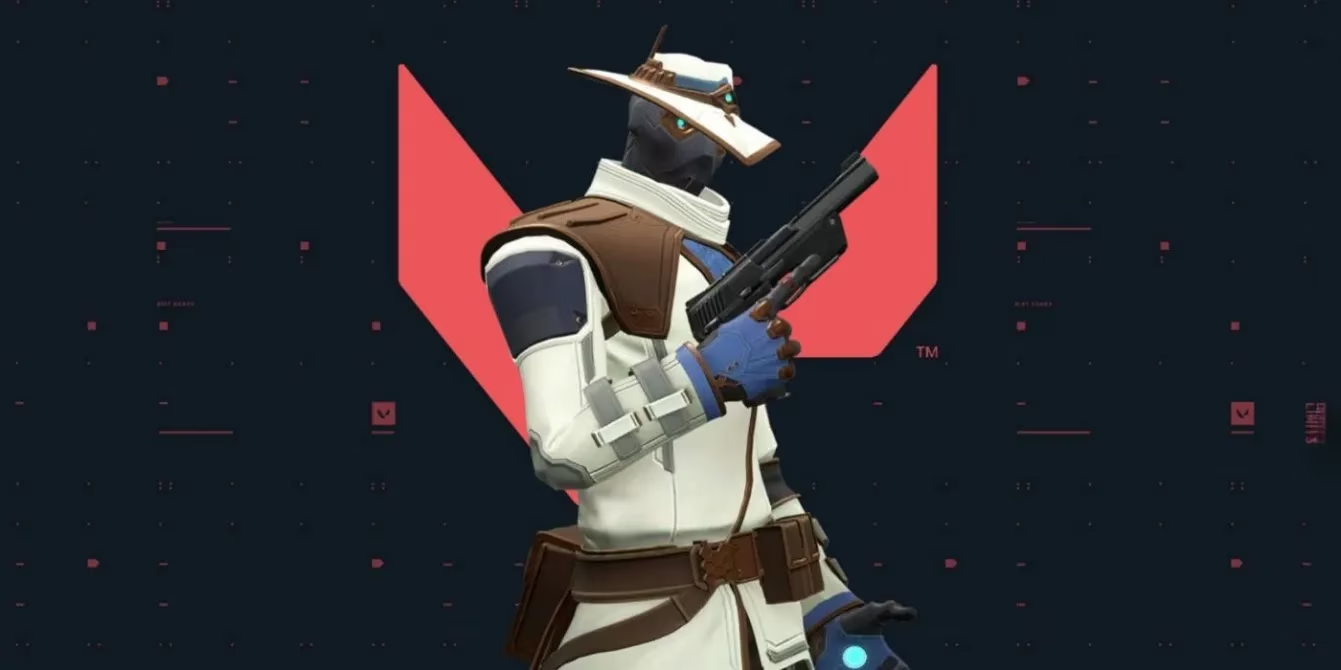
The glitch was born from an unexpected marriage of abilities. Sage, the Radiant healer, could conjure barriers of solid jade — walls that rose from the ground with the sound of grinding stone. These structures were never meant to last; a focused volley of bullets could shatter them into fading pixels. When a player stood upon such a wall and the wall was destroyed, gravity was supposed to reclaim its due. Down they would fall, a predictable descent. But Cypher, the one who traded sight for secrets, carried a camera — a Spycam — that allowed him to peer through its lens in first-person. Should he be looking through that remote eye at the very moment the ground dissolved, a miracle occurred: he remained suspended. A ghost in the machine, frozen in the air as if sealed in amber.
The apparition was not without its chains. Cypher had to stay tethered to the camera's vision, his own body a limp marionette while his consciousness drifted. The moment he released the link, gravity would remember him and pull him back to the earth, a brief plummet that restored order. But until then, he hovered — a phantom lantern hanging in unexpected corners. As if time itself had forgotten to breathe in that narrow slice of space, he became a creature of stillness, a figure caught between two frames of a movie reel.
Such a curious anomaly quickly drew the attention of those who prowl the borders of competitive integrity. On a Reddit thread long since archived, a user named TheNeoStrike illustrated the exploit with a surgical demonstration. At the onset of a match on a sun-bleached map, this Cypher ascended a Sage wall near a doorframe and entered his camera. The wall was then broken by a teammate, and Cypher remained aloft — a silent gargoyle perched just above the lintel. Later, when two foes sprinted through the doorway, their eyes scanning the floor and the corners but never the ceiling, Cypher detached from his trance, dropped noiselessly, and cut them down from behind. It was a move that felt less like a gunfight and more like a betrayal of the air itself, a dagger drawn from a cloud.
This glitch, though fleeting in the game’s lifespan, became a fable. It was a tiny tear in the fabric of the simulation, akin to a misplaced stitch in an astronomer’s tapestry that briefly reveals a second, darker sky behind the stars. Developers at Riot Games, ever the vigilant cartographers of their ever-expanding universe, would soon seal this loophole with a patch — perhaps in Update 0.47, which already adjusted the balance of Raze and Sage. The walls would fully reclaim their logic, and the floating Cypher would become a memory, a story exchanged by veteran players who recall the beta with a nostalgic squint.
Yet in the echoing corridors of 2026, where Valorant has evolved into a sprawling continent of modes and lore, that old glitch persists as a spectral thread in the community’s imagination. It surfaces in the way a new player, having just unlocked Cypher, is occasionally warned: "Remember, you’re not a drone. You can’t just hang in the air." It lingers in the design philosophy that gives every vertical nook a clear purpose, ensuring no overlap of abilities creates a silent perch. The memory is a faint watermark on the lens of every Cypher camera, a reminder that once, the line between watcher and watched was blurred by a bug so elegant it seemed almost intentional.
The glitch’s soul is preserved in the art of surprise. Modern Cypher mains, though bound by the corrected code, still seek out that shadowed ledge, that unseen corner, that high place where they can peer unseen. The hover may be gone, but the desire to become a ghost remains — an aspiration crystallized in those early beta days when a man could float like a forgotten note in an unfinished symphony, his silhouette a temporary chalk line against the ceiling, waiting for the cue to fall.