It is 2026, and Valorant has evolved into a tactical shooter with more agents than a superhero team-up movie, but once upon a time—specifically in patch 2.09—Riot Games decided to stir the pot with a limited-time mode called Replication. The update was not a seismic overhaul, yet it left a trail of chaos, nerfs, and bug fixes that still makes veteran players nostalgic. What happens when a whole team picks the same agent and abilities refresh every round? Absolute nonsense, obviously.
Replication: Five Agents, One Brain Cell
Replication sounded like something a chaos-loving modder would invent after too much coffee. It was essentially a best-of-nine take on Valorant’s basic game mode, but with a twist: every player on a team played as the same agent, and all abilities except ultimates automatically refreshed each round. Five Vipers? Five Breaches? Five Yorus running around like caffeinated ninjas? The mode was a beautiful disaster waiting to happen.
Riot also added a much-needed “flashguard.” If a player got hit by flash abilities twice in a four-second window, they became immune to flashes for five seconds. One might ask: was this a balance fix or a mercy rule for anyone who had ever been blinded six times in a row by a coordinated enemy team? Either way, it made Replication slightly less of a headache and slightly more of a tactical circus.
Viper Gets a Gentle Slap
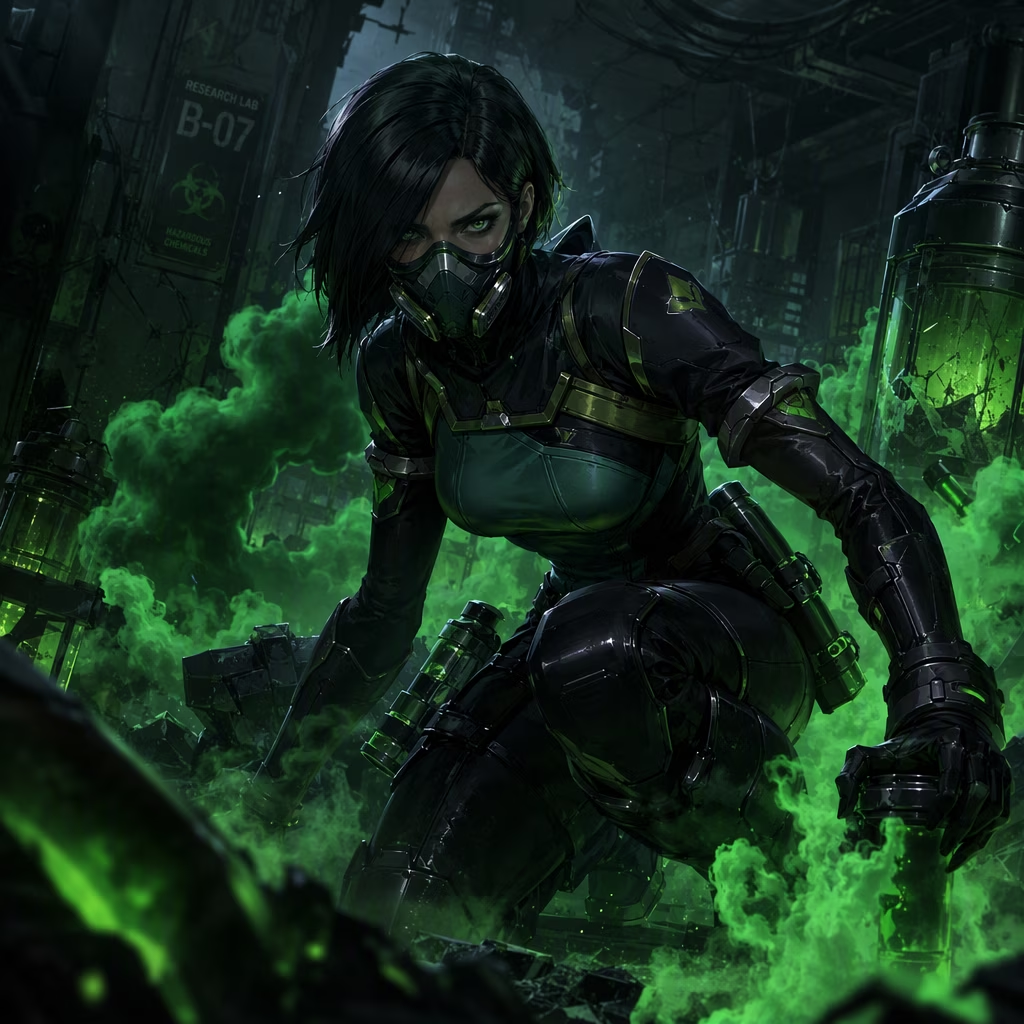
Riot’s ongoing quest to balance Viper continued in update 2.09, though this time it was actually a slight nerf. Viper had been significantly buffed back in 2.06, which made any contact with her toxin powers automatically deal 50 decay. That number was adjusted down to 30 decay in 2.09 because the developers felt it had become so powerful that players avoided it at all costs.
The reasoning was simple enough. Before the previous change, enemies tended to disregard Viper’s smoke and simply push through it. But with instant decay at 50, the pendulum swung too far in the other direction—her possible victims would avoid the smoke like it was a radioactive birthday party. Riot hoped to find a balance point where opponents, with proper coordination and utility usage, could break through her smoke. Likewise, Viper players would now attempt to stay a step ahead and counter the enemy’s plans to capitalize on the opening her debuffs applied.
Riot also believed that the tuning, along with the bullet damage breakpoints of the game’s guns, would maximize decay’s power when both sides were on full buys. At the same time, it removed some of the more outsized effects that 50 decay had, such as its one-shot kill combination with the Marshal and its impact in pistol-versus-pistol fights.
Breeze, Timeouts, and Quality-of-Life Chaos
Patch 2.09 also blocked the gaps above Mid-Wood Doors and A Metal Doors on the map Breeze. It smoothed player collision in various locations. And it added 60-second tactical timeouts to Tournament Mode Custom Games. Two tactical timeouts could be called per game, per team. Those timeouts lasted 60 seconds and froze all player movements for the duration. For technical pauses, the standard Pause Match Timer option remained available.
Observers got some love too. The patch improved the visual synchronization of bullet tracers and impact effects for Observers. It adjusted the color of placeable utility on the minimap to match team color. It also adjusted the color of names in the player loadout HUD to match team color. Placed Agent abilities gained team colors for observers. In Custom Games, the End Game Phase and Pause Match Timer options were spaced out to prevent misclicks. Players also got improved feel on rope ascenders in high-latency situations, plus minor performance optimizations to the UI in matches.
The Bug Fix Parade
No Valorant patch is complete without a parade of bug fixes, and 2.09 delivered a wonderfully random assortment. Here are some of the highlights:
| Bug | Fix |
|---|---|
| Astra’s Nebula was slightly offset once fully formed | Corrected |
| Sova’s Owl Drone wing bullet impacts appeared in wrong locations | Fixed |
| Incorrect damage icons for abilities showed up in the killfeed | Fixed across multiple Agents |
| Killjoy’s Nanoswarm audio cut off if destroyed right after activation | Fixed |
| Skye’s Seekers did not show how many enemies were affected in combat report | Fixed |
| Omen could drop the Spike or weapons while casting From the Shadows | Prevented |
| Killjoy’s Alarmbot displayed flashed visual effects while invisible | Fixed |
| Weapons could be instantly reloaded after spamming orb pickups | Fixed |
| Sound was lowered by 5dB | Fixed |
| 1P snow impacts rarely occurred in gun fights | Fixed |
| A number of exploits around the map | Fixed |
| Players could sandwich themselves between Sage’s wall and Mechanical Doors on Breeze or Ascent | Fixed |
| Leaderboard rank did not show up on Act Rank badge | Fixed |
| Ranked rating threshold for previous Acts appeared on leaderboard | Fixed |
Who knew a 5dB sound bug could be patched alongside a Sage wall sandwich exploit? Valorant patch notes have always been a grab bag of tactical adjustments and deeply cursed technical gremlins.
The Legacy of 2.09
In 2026, Replication is a distant memory, but its spirit lives on in every chaotic limited-time mode that Valorant has released since. Patch 2.09 proved that even a relatively minor update could spark big arguments about Viper’s smoke, Breeze’s sightlines, and whether five identical agents is a dream or a nightmare. Was it a masterpiece? No. Was it memorable? Absolutely. And if one ever wonders why modern Valorant players still debate Viper’s decay numbers, the answer likely starts with a small patch from long ago.