As a dedicated player and observer of the tactical shooter scene, I've witnessed Riot Games' Valorant evolve from its explosive launch into a cornerstone of the competitive gaming landscape. Looking back from our current vantage point in 2026, it's fascinating to reflect on pivotal moments that shaped the game's development philosophy. One such critical juncture was the notorious 1.11 update, a release that became synonymous with technical challenges and ultimately accelerated the implementation of a feature the community had long requested: public test servers.
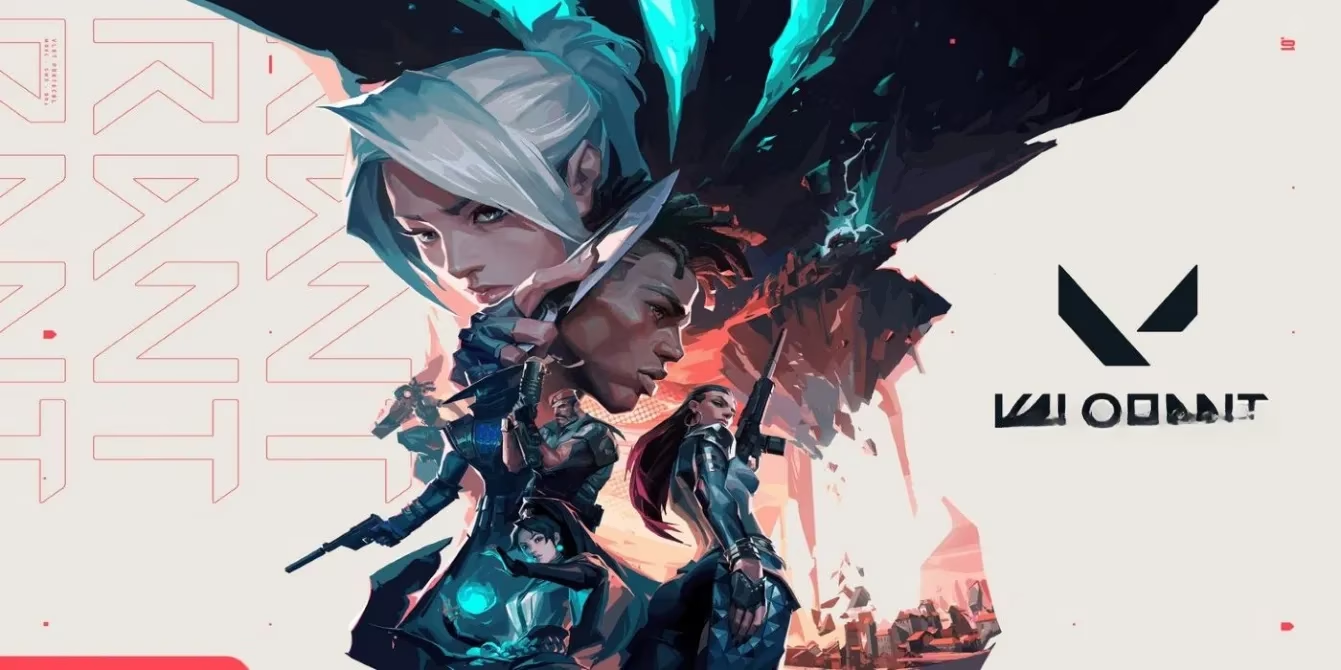
The journey of Valorant's 1.11 update serves as a classic case study in live-service game management. I remember the period vividly. Riot Games, in the midst of the game's third Act—a content-rich phase introducing a fresh map, a new battle pass, and more—deployed the update with high expectations. It promised significant meta shifts with the debut of the initiator Agent, Skye, alongside substantial adjustments to existing characters like Breach, Cypher, and Killjoy. The anticipation within our community was palpable. However, what followed was a stark reminder of the complexities inherent in updating a globally synchronized, competitive title. The update introduced a cascade of instability issues, particularly in regions like North America, Brazil, and LATAM, problems so severe that the developers themselves labeled the situation a "technical nightmare."
Faced with widespread disruptions, Riot made the decisive, albeit difficult, choice to roll back the entire 1.11 patch. This wasn't a simple hotfix for a single bug, like the infamous Sova drone glitch that had popped up before. This was a full-scale retreat. For players like myself who had eagerly unlocked and begun progressing Skye's contract, our advancement was abruptly put on hold. The official communication was clear: progress would be preserved and resumed once a stable version of the patch was redeployed, which Riot promised would happen within a week. This incident wasn't just about a buggy update; it was a direct hit to player trust and momentum during a crucial seasonal phase.
The Community's Call for Change: Birth of the PBE
This event acted as a catalyst, amplifying a long-standing community request into an urgent demand. For years, players had pointed to Riot's other flagship title, League of Legends, and its robust Public Beta Environment (PBE). We argued that a similar framework for Valorant could prevent such widespread deployment disasters. The core benefits we advocated for included:
🎯 Early Feedback on Balance: Testing Agent tweaks and new abilities in a live-but-separate environment.
🔧 Technical Stress Testing: Identifying server-side and client-side bugs before they hit the global live servers.
⚖️ Meta Forecasting: Understanding how new Agents or map changes might shift the competitive landscape.
The 1.11 debacle proved our point. Riot acknowledged that a public test server was in the works, but its arrival simply hadn't aligned with the 1.11 update cycle. The post-mortem was clear: a PBE could "nip issues in the bud," preventing a localized problem from becoming a global community-wide headache.
The Legacy in 2026: A Transparent Development Cycle
Fast forward to today, in 2026, and the impact of that period is deeply ingrained in Valorant's development rhythm. The Public Test Environment (PTE), as it's now known, is an integral part of the game's ecosystem. Major updates, especially those introducing new Agents or sweeping balance changes, now routinely spend time on the PTE. This process has fundamentally changed the relationship between the developers and the player base.
| Aspect | Pre-PTE (e.g., Update 1.11) | With PTE (2026 Standard) |
|---|---|---|
| Update Stability | High risk of game-breaking bugs on launch. | Bugs are identified and often fixed prior to global launch. |
| Community Input | Limited to feedback after live deployment, often reactive. | Proactive feedback shapes final tuning before main release. |
| Launch Experience | Often disruptive, requiring quick fixes or rollbacks. | Generally smoother, with known issues documented in patch notes. |
| Developer Workflow | "Fire-fighting" mode post-launch. | More controlled deployment with curated feedback. |
This shift has allowed Valorant to grow with "fewer hiccups," as Riot hoped. While no live service game is ever perfectly bug-free—I recall the excitement and subsequent fine-tuning around the limited-time snowball fight mode dataminers found evidence of years ago—the update process now feels more collaborative and polished. The nightmare of 1.11 transformed into a valuable lesson in operational resilience. It underscored that for a game demanding precise mechanics and competitive integrity, stability is not just a feature but a foundation. The PTE acts as a vital bridge between Riot's innovative designs and the community's experienced gameplay, ensuring that new content, from casual modes to ranked adjustments, enhances the experience rather than disrupting it. The technical stumble of the past has paved the way for the confident stride of the present.