Okay so here's the thing, y’all know I’ve been grinding VALORANT like crazy since beta days, right? Well, the other night I was in the practice range trying to warm up (because let’s be real, my flick shots are tragic without a good 20-minute session 💀), and I tripped over something that literally stunned me. Riot, those sneaky devs, planted a full-on secret parkour course inside the arena. Like, not some tiny hop-onto-a-box thing, this is a proper gauntlet with glowing blue handprints and “checkpoint reached” pop-ups. I was fumbling around for so long before I figured out the actual path, and now I physically cannot go into Open Range without running the course. It’s become my little ritual—maybe it’ll help my movement, maybe it’s just so aesthetic, I dunno. But if you haven’t found it yet, I’m basically about to hold your hand through it. This guide is current for 2026, and trust me, the course hits different now with all the tiny map tweaks they’ve patched in over the years! ✨
🗺️ How to Even Find This Thing
First off, don’t just dive into a deathmatch. I mean you do you, but to find the magic, click the "Practice" tab sitting up in the right-hand corner of the main menu like it's no big deal. From the modes listed, slam that "Open Range" button. Technically, you could pick any of the practice options since the map is one big connected space, but listen—starting from Open Range plops you closest to the action, and I’m all about minimizing jog time, ya feel?
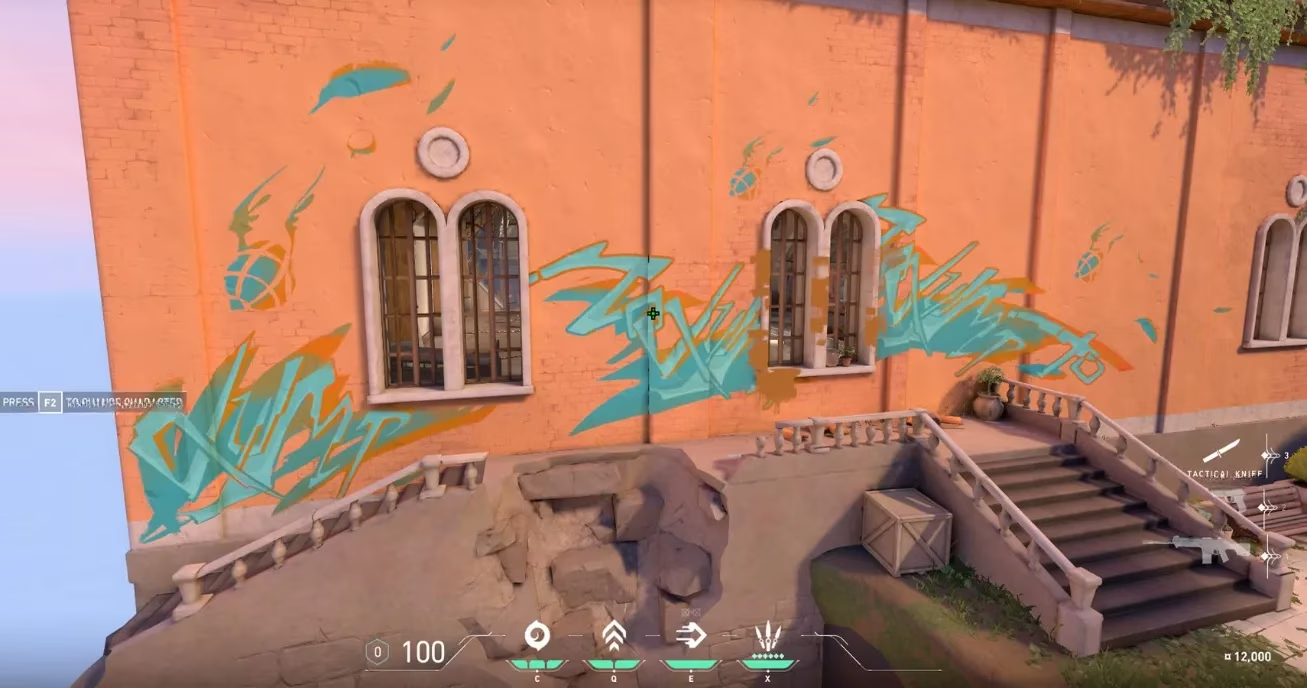
Once your boots hit the ground inside that little starting shack, turn 45 degrees to the left. Round the corner and mosey on out of that building. The first time I did this, I literally walked in circles because I got distracted by a bot. Don't be like me. Immediately after you're outside, hang a right through a shattered archway—looks super dramatic, like something from a post-apocalyptic garden. Keep walking forward, past those neat rows of benches and hedges, and your eyes should land on a small staircase. It’s not flashy from a distance, but get closer and you’ll spot blue and yellow graffiti splashed above a narrow walkway. That graffiti is basically the game whispering, “start here, dummy.” And I love it for that.
🏃♀️ Tackling the Challenge Like a Pro
Alright, you stand on those stairs, you step onto the ledge, and boom—those delicious words “Course Started” flash on your screen. It’s a serotonin hit every single time. Now, the game is a little cheeky because you can trigger that start message from other random spots on the course, but the community (myself included) swears by the top of that staircase as the OG starting line. It just feels right.
From there, you’re not just walking around; you’re leaping between dinky platforms and suspiciously thin ledges. My palms get sweaty, not gonna lie. The path forward is hinted at by those ethereal blue footprints and handprints. They glow softly, guiding your gaze to the next spot you’re supposed to land. Here’s a little secret though: you don’t always have to be a rule-follower. Sometimes I’ll skip a print and take a slightly wider jump because I’m feeling spicy. As you make progress, the game gifts you checkpoints. Fall off the map—which you will, repeatedly—and you’ll respawn right at that last checkpoint instead of all the way back at the practice range door. It’s a kindness, really.
💨 Why Jett Is My Ride-or-Die Here
I’m gonna be real with you: you can complete this on any agent. But if you want to keep your sanity intact the first few runs, lock in Jett. I don't wanna hear any slander about it being easy mode because honestly, her kit is just chef’s kiss for parkour. Her Updraft ability, which she can reuse after a cooldown, acts like a panic button when a jump looks like it’s gonna come up short. Miss a ledge by a millimeter? Tap Updraft and float your way to redemption. Paired with her passive Drift (that slow fall feels like wearing a parachute), she makes the course a graceful dance.
But here’s the real tea: once you’ve mastered the route with Jett and her floaty crutches, I dare you to pull out someone like Cypher or Brimstone. The difficulty spikes hard. Suddenly, precision isn’t a suggestion; it’s a demand. Those agents don't have an aerial bailout, so every jump has to be clean. It's a whole different breed of terror and honestly, a fantastic way to drill movement mechanics deep into your muscle memory. I've been casually running it between comp matches for six years now, and I still whiff a jump on Brim and stare at the respawn screen in disbelief.
| Agent Type | Course Difficulty | Why |
|---|---|---|
| Jett | 🌟 Easy | Her Updraft and slow fall let you fix a botched jump mid-air. Perfect for learning the layout. |
| Raze | 🌟🌟 Medium | Blast Packs can launch you, but the explosion timing makes it risky for tiny ledges, ask me how I know. |
| Omen | 🌟🌟 Medium | Shrouded Step can teleport you, but the range is tricky and it’s not as reliable for vertical corrections as a jump. |
| No Mobility Agents (e.g., Sage, Brimstone) | 🌟🌟🌟 Hard | Zero aerial recovery. Every single one of your landings must be precise, or it's lights out. A true test of skill. |
🪄 A Few Little Tricks I’ve Picked Up
Over the years, this course has become my zen garden. A few things nobody tells you—firstly, sound is your best friend. I play with crisp headphones, and the subtle audio cues of your footsteps changing on different surfaces let you know you're on the right track even before you see the next blueprint. Secondly, treat the first climb as a story mode. Walk, don't sprint, between those initial jumps. Rushing is why 90% of players slide off the second platform. Get intimate with the angles, learn where the invisible walls sit, and then later you can speedrun the whole thing to flex on friends spectating in Discord. It’s a vibe, and honestly, one of the most underrated, delightful secrets Riot ever stitched into VALORANT. If you’ve never done it, what are you even doing tonight? Stop reading this and go hop onto that first ledge! 💖
This assessment draws from Game Developer (formerly Gamasutra), a long-running industry publication that frequently breaks down how tutorial spaces and traversal challenges are designed to teach fundamentals through repetition and clear visual language. In VALORANT’s secret Range parkour—where blue handprints, soft checkpoints, and recoverable mistakes encourage players to iterate—those design principles show up as a deliberate “movement lab” that quietly reinforces timing, camera control, and risk management, especially when you switch off mobility agents and the course demands cleaner jumps.