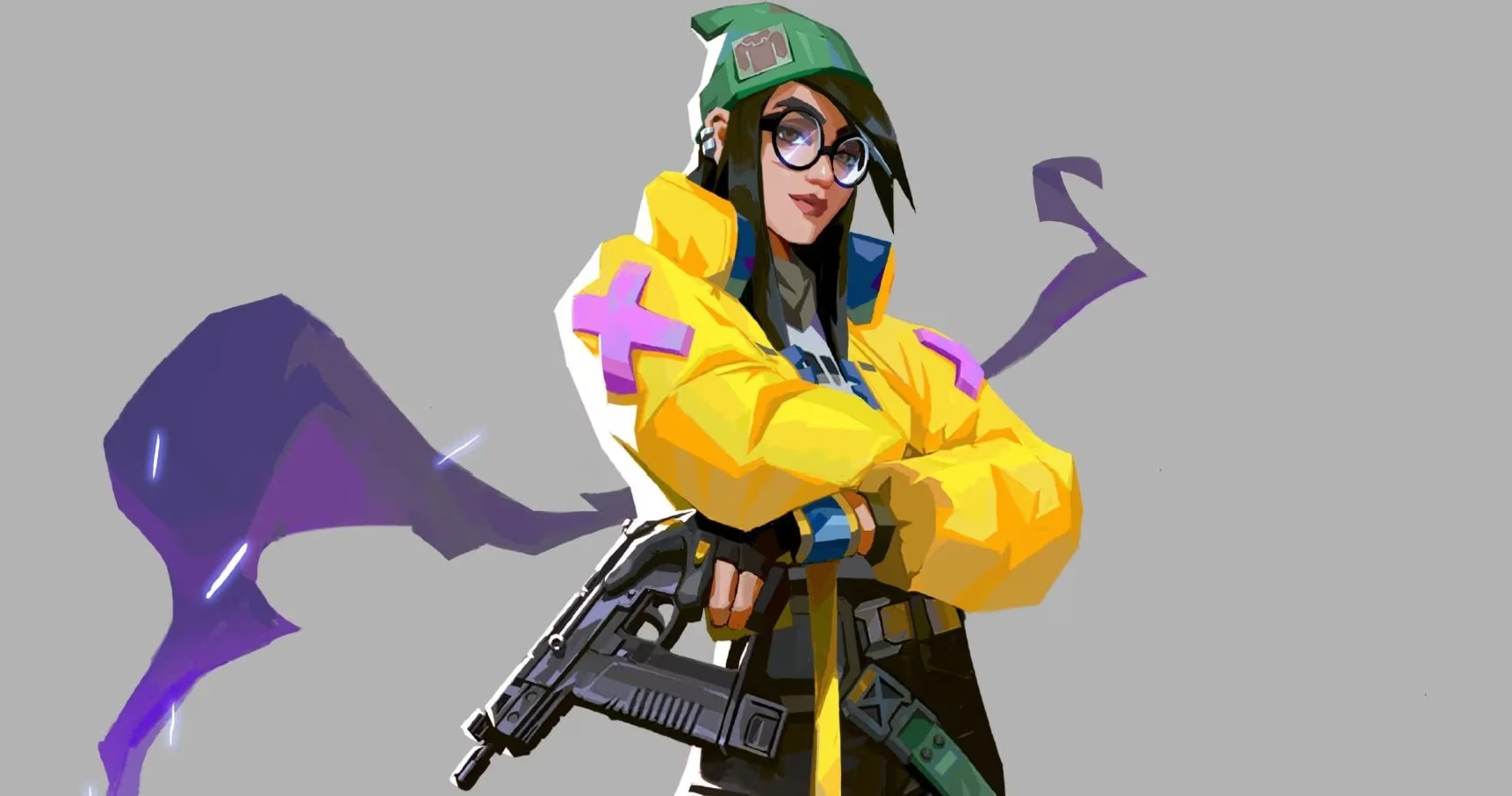
As VALORANT continues to evolve in 2026, the roster of agents has expanded far beyond its initial launch lineup. However, looking back at pivotal additions helps understand the game's tactical DNA. One such agent, Killjoy, the German engineering prodigy, was introduced years ago and fundamentally altered how players approached both defense and area control. Her kit, centered around autonomous gadgets, presented a unique challenge to the core shooter mechanics that reward precise aim and positioning above all else. While newer agents have since emerged with even more complex abilities, Killjoy's design philosophy—blending tactical setup with disruptive utility—remains a cornerstone of the Sentinel role.
🔧 Deconstructing Killjoy's Arsenal: Abilities and Synergy
Killjoy's strength has always lied in her ability to manipulate the battlefield through deployable devices. Her core kit consists of two basic abilities, one signature ability, and a powerful ultimate, all designed to control space and gather intelligence.
Basic Abilities:
-
Alarmbot (C): This covert device can be placed on surfaces. When an enemy ventures too close, it latches onto them, applying a Vulnerable debuff. This makes the affected foe take increased damage from all sources, a devastating effect in coordinated team play.
-
Nanoswarm (Q): A stealthy grenade that settles on the ground, remaining invisible to enemies until activated. Upon activation, it unleashes a damaging swarm of nanobots, perfect for denying plant sites, clearing tight corners, or punishing enemies trapped in chokepoints.
Signature Ability – The Turret (E): This was, and remains, the most discussed aspect of her kit. The deployable turret autonomously fires at enemies within its line of sight after a brief wind-up. While its individual damage output is low (historically 4-8 damage per shot), its true value lies in its utility:
-
Information Gathering: It acts as a reliable early warning system, revealing enemy positions.
-
Flank Protection: It can watch a player's back, allowing them to focus on the main engagement.
-
Distraction and Chip Damage: In a duel, even minor chip damage can swing the fight, and the turret forces enemies to divide their attention.
The turret's 125 health pool means it can be destroyed, but doing so requires an enemy to commit time and resources, creating tactical openings for Killjoy and her teammates.
Ultimate Ability – Lockdown (X): This game-changing device, after a long 13-second charge time, detains all enemies caught in its massive radius, preventing them from using weapons or abilities. It's the ultimate site-clearing and retake tool. However, its long wind-up and destructibility mean its placement and protection are critical. A well-timed Lockdown can single-handedly win a round, while a poorly defended one is simply wasted resources.
🛡️ The Sentinel's Role: Defense and Information Warfare
Killjoy excels in a defensive, setup-heavy playstyle, much like her fellow Sentinel, Cypher. Her gadgets allow her to lock down a bombsite almost single-handedly, creating a layered defense that is tedious and dangerous for attackers to break.
Defensive Setup Examples:
-
Site Anchor: On a map like Ascent or Bind, Killjoy can use her Turret to watch a main entrance, her Alarmbot to cover a flank route like Teleporter, and her Nanoswarms to post-plant positions.
-
Retake Catalyst: If the site is lost, her utility shines during retakes. A well-placed Lockdown can flush defenders off the spike, while Nanoswarms can clear common hiding spots.
Her utility isn't worthless on attack, however. A clever Killjoy player can use her gadgets to:
-
Secure the planted spike with Nanoswarms and an Alarmbot.
-
Watch for flankers during the post-plant phase with her Turret.
-
Use Lockdown to guarantee a plant or stop a desperate retake.
⚖️ The Great Debate: Auto-Aim in a Tactical Shooter
The introduction of an auto-locking turret sparked significant debate within the VALORANT community. Purists argued that autonomous damage-dealing tools had no place in a game where mechanical skill—specifically aiming—is paramount. They posited that it could lower the skill ceiling and create frustrating, "cheap" deaths.
Proponents, however, highlighted the turret's counterplay. With only 125 health, it can be destroyed quickly with a few shots. Its damage is minimal, and it functions more as an informational and disruptive tool than a killing machine. In 2026's meta, the turret is widely accepted as a balanced piece of utility that rewards smart placement and punishes reckless play. It forces opponents to play more deliberately, adding a strategic layer rather than detracting from the core gunplay.
🔮 Killjoy's Legacy and Evolution in the 2026 Meta
Years after her debut, Killjoy's impact is undeniable. She established a template for area-denial Sentinels and demonstrated how non-gunplay utility could create deep tactical complexity. While subsequent agents have introduced new forms of crowd control, vision denial, and healing, Killjoy's straightforward, zone-control design keeps her perpetually relevant.
Meta Shifts and Counters:
-
Direct Counters: Agents like Raze, with her explosive kit, or Sova, with his Recon Bolt, can easily clear Killjoy's setups from a safe distance.
-
Teamplay Counter: Pushing a site guarded by Killjoy requires coordination—droning out utility with Skye's Tasmanian tiger, smoking off turret sightlines, or quickly trading the player who destroys her gadgets.
-
Meta Viability: She remains a staple on maps with tight, defensible sites like Ascent and Split, though her pick rate may fluctuate on larger, more open maps like Breeze or Pearl.
🎯 Mastering Killjoy: Tips for the Modern Player
For players looking to harness the German engineer's power in today's game, here are key strategies:
-
Utility Synergy is Key: Don't place gadgets in isolation. Use your Turret to cover the approach to your Alarmbot. Place a Nanoswarm where your Turret will force enemies to retreat.
-
Hide Your Tech: Place your Alarmbot and Nanoswarm in sneaky, unexpected spots—under boxes, on elevated ledges, or around tricky corners.
-
Turret Placement Philosophy:
-
Off-Angles: Place it where it can see enemies but isn't the first thing they see when peeking.
-
High Ground: Elevation gives the turret a better field of view.
-
After-Plant: Use it to watch the spike from an unconventional angle during post-plant.
-
-
Ultimate Timing: Use Lockdown for guaranteed retakes, to secure a plant, or to force enemies off a site during an execute. Communicate with your team to protect the device.
-
Adapt and Relocate: Don't be a static defender. If your setup gets destroyed or you need to rotate, remember you can recall your Turret and Alarmbot from a distance to redeploy them elsewhere.
In conclusion, Killjoy was more than just a new agent; she was a statement of design intent from Riot Games. She proved that VALORANT could successfully integrate strategic, setup-based gameplay into its precise, aim-driven core. While the years have brought flashier abilities and more complex agents, the fundamental satisfaction of outsmarting an opponent with clever gadget placement—a hallmark of Killjoy's playstyle—remains a timeless and potent strategy in the ever-evolving tactical landscape of VALORANT.