The year was 2020—a strange spring where the world outside felt suspended in amber, yet within my room, a new battlefield bloomed into existence. Valorant’s closed beta had barely taken its first breath, and already, the symphony of gunfire and agent whispers had carved a permanent home in my chest. I remember the hush of anticipation as Riot Games unfurled update 0.49, a patch that felt less like a technical note and more like the universe’s first careful edit of a masterpiece still learning its name.
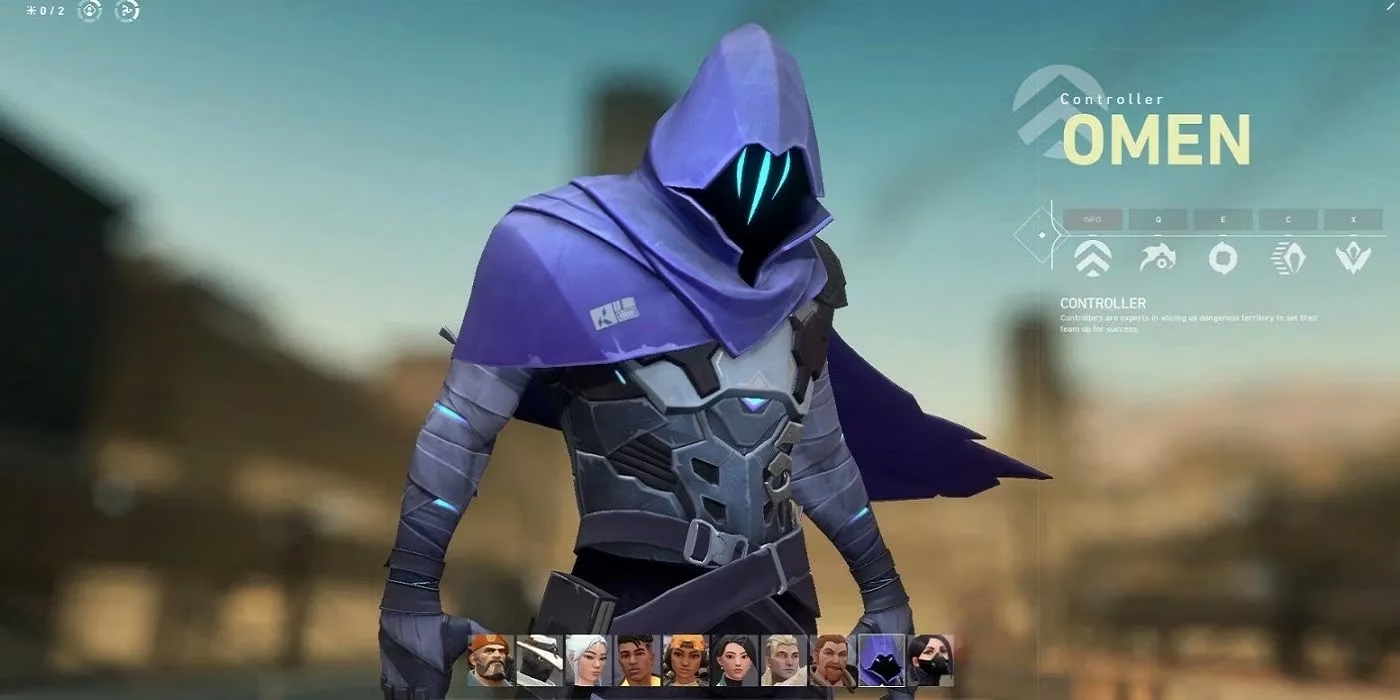
Omen—my shadow-cloaked phantom—emerged from that patch with a new, fragile honesty. When he shed his shadow form, the world instantly recognized his vulnerability; no longer could I lurk in ambiguous twilight, a ghost untouchable. The patch notes sang a mournful tune: “players have to be closer to him to know where he's using his From the Shadows ability to teleport to.” Gone were the days of distant paranoia—now, an enemy could scent my arrival like a storm drawing near, the air thickening with dread in a tighter radius. It taught me the art of risk, the poetry of a decisive unveiling. I’d weave through smokes, my footsteps a staccato heartbeat, and then emerge, suddenly naked under the harsh light of an opponent’s crosshair. In those split-seconds, I found a new language: the dialect of abrupt confrontation.
Sage’s Barrier Orb, too, learned humility. The patch decreed that her crystalline walls would “only spawn a chunk of the barrier if it is supported by the ground.” No longer could they sprout defiantly from tiny ledges or mischief-prone geometry—a box, the earth itself, these became the only canvases. I recall standing on Haven’s B site, staring at the double doors where once a Sage might lift herself to a god’s-eye view. But the curtains had been added atop those doors, a velvet softness to block the exploit. The barrier became less a conjurer’s trick and more an architect’s measured declaration. I mourned the loss of those floating ice-shelves, yet grew to respect the discipline: a silent agreement between player and world that some boundaries are sacred.
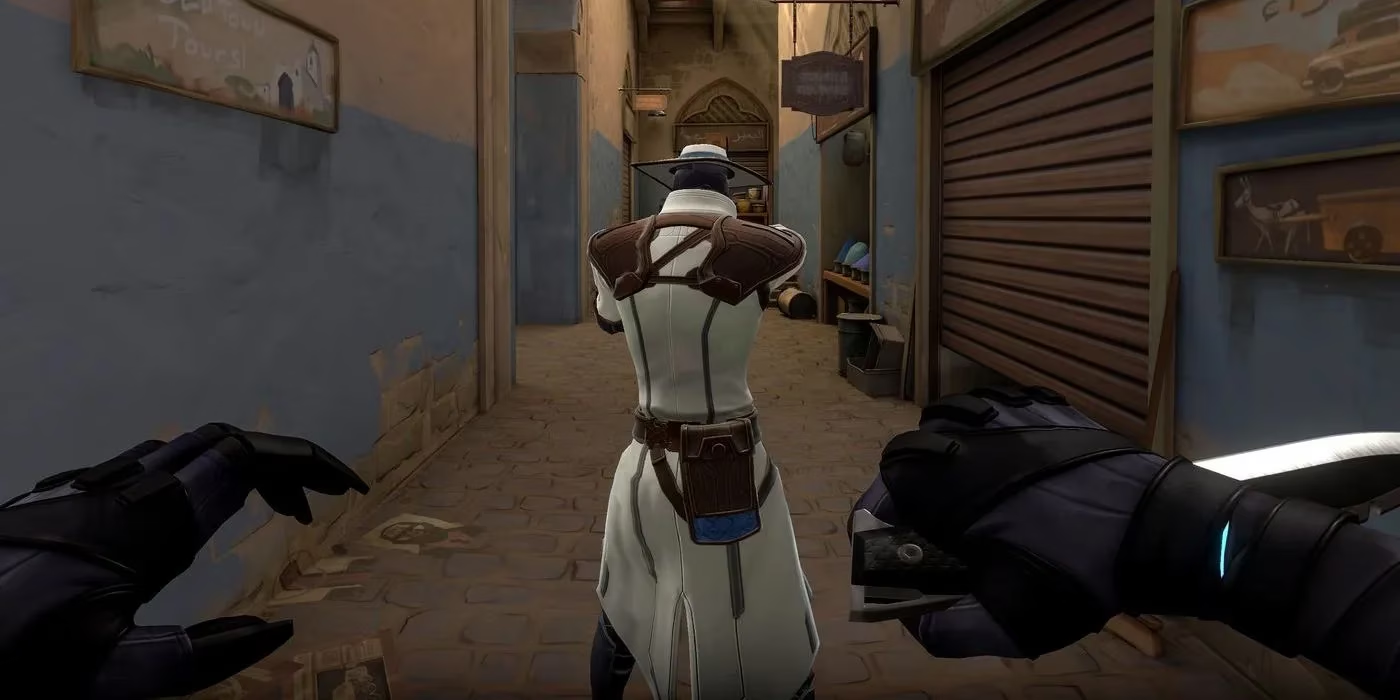
And poor Cypher—his Spycams no longer clung with spiderlike defiance to the A main boxes on Haven, a fix that echoed the earlier salvation from 0.47’s game-breaking bug. I had been there, in the depths of that bug, watching a camera slide through matter like a spirit rejecting its body. Now, in 0.49, the geometry was a fortress once more. Riot whispered a “massive thanks” to the closed beta testers who hunted these exploits across Bind and Split, and I swelled with pride, knowing my hours of patient reporting had helped carve a cleaner dreamscape.
There were whispers, too, of what lurked beyond the immediate. The patch prepared us for ranked mode, a promised land where every kill would be weighed, every clutch measured. Riot spoke of it “going live in the near future,” and I felt the thrill of a society on the cusp of hierarchy. Last week’s confirmation of ranked details had been a beacon, and now, in 0.49, the foundation solidified. I imagined the leaderboard, a constellation of names, mine among them, climbing or falling like a breath. The closed beta was no longer just a playground—it was a proving ground, the soil where legends would soon plant their roots.
Another quiet gift arrived: Observer Mode’s Ghost Cheat. In custom games with cheats enabled, I could finally don the mantle of a silent god, flying through the map in no-clip mode. What a liberation—to drift through walls, to see the map’s arteries from an angel’s eye, to understand sightlines as a celestial cartographer. There was also the simple mercy of a “Leave match” button in the ESC menu, a sancturay for custom lobbies where no punishment awaited my departure. Such small courtesies made the beta feel like a home whose hosts listened to every weary sigh.
Breach and Omen received visual updates too, a subtle polishing of avatars I had come to love. Breach’s seismic devices glinted with fresh menace, and Omen’s skin shifted with richer shadow—a reminder that beauty and terror often dance together. These artists of Riot were not just coders; they were dream-sculptors, chiseling identity out of polygons.
Looking back from 2026, I see that patch 0.49 was a keystone in the arch of Valorant’s growth. The game was still a whispered secret among a chosen few, yet within those weeks, Riot demonstrated a master’s urgency. They fixed the small agonies—the map exploits that broke Immersion, the camera glitches that turned armor into paper, the Sage wall that reached too far into the sky. Each nerf was a verse in a larger epic, teaching us that balance is not a static goal but a living rhythm.
I remember a particular round on Split, post-patch, where Sage’s wall obediently rooted to the ground, a solid shard of hope. Omen lurked behind me, his vulnerability a shared burden. We pushed through mid, the new curtains on Haven’s doors fresh in our minds, a reminder that the world could be reshaped in a single update. That round wasn’t special in score, but in feeling—the sense that the game was listening, evolving, becoming something more than code. It was becoming memory.
Now, in 2026, Valorant stands as a colossus, its esports arenas roaring, its agent roster a vast pantheon. But I still close my eyes and return to patch 0.49, the gentle tremor that reminded us: every fortress is built on the shoulders of small, necessary ruins. Omen’s shadow-limitations, Sage’s barrier humility, the curtains on Haven—these were the brushstrokes that painted a future we now inhabit. The ranked mode that was just a whisper then is now a roaring river; the Ghost Cheat that felt like a miracle is now history. The closed beta testers, myself among them, were apprentices to a magic that would conquer the world. Patches like 0.49 were our textbook, and its lessons echo every time I anchor a site, every time I let fate decide my position in the scoreboard. And so, I write this not just as a player, but as a poet who witnessed the dawn, and knows that the light we see now first flickered in those tiny, meticulous notes.